Home › Guides › Repeater basics for new Technicians
Repeater basics for new Technicians
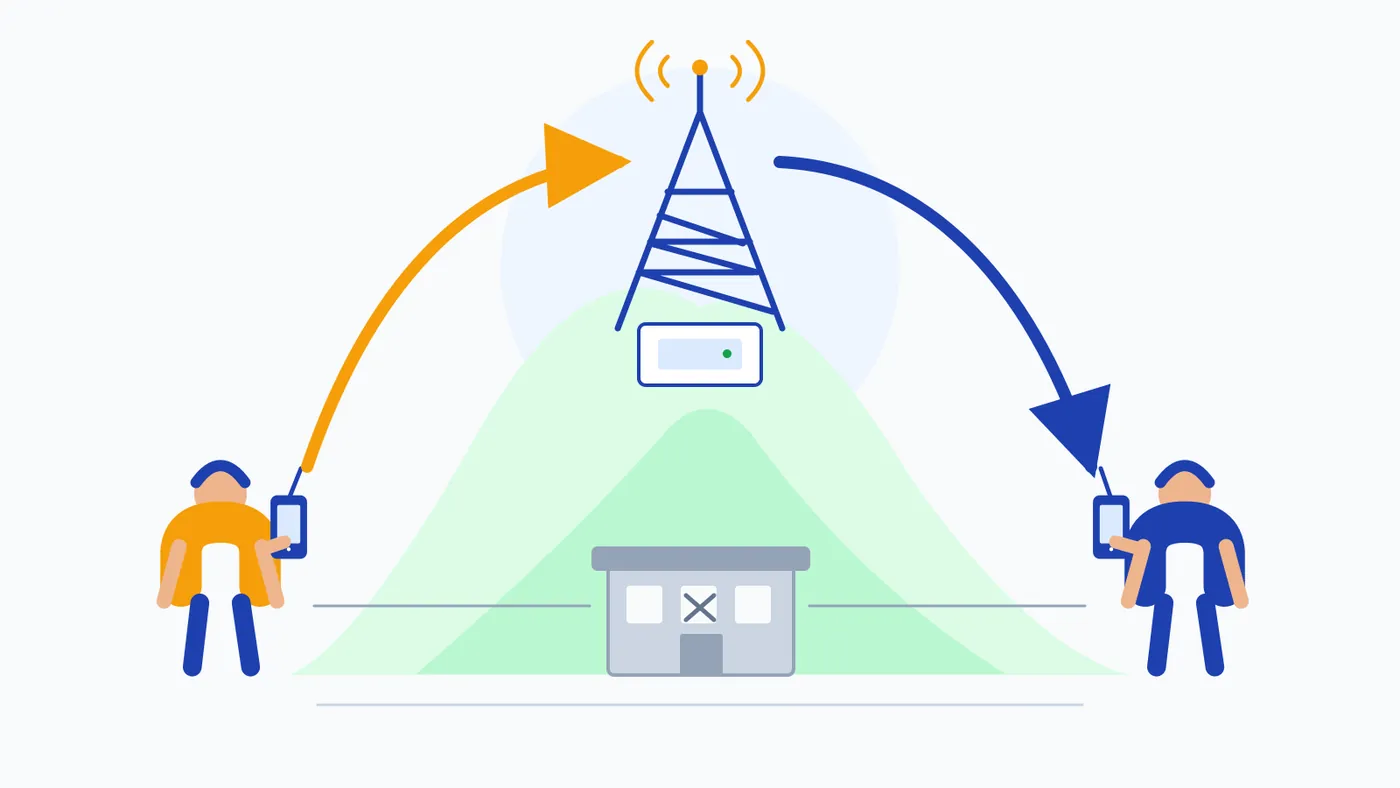
A repeater sits on a hilltop or tall building, listens on one frequency and retransmits on another. It lets a small handheld radio reach across a whole city. Most new Technicians make their first contacts through one.
Updated 2026-10-23
Offset: two frequencies, not one
A repeater receives on its input frequency and transmits on its output frequency. The difference between them is the repeater offset (T2A07). You listen on the output and your radio shifts to the input when you press the mic button.
The common offsets are what the exam asks about:
| Band | Common offset | Exam question |
|---|---|---|
| 2 meters (144-148 MHz) | plus or minus 600 kHz | T2A01 |
| 70 centimeters (420-450 MHz) | plus or minus 5 MHz | T2A03 |
Tone: the key that opens the door
Many repeaters only respond when your signal carries a sub-audible tone along with your voice. This is CTCSS, often just called PL or tone (T2B02). Repeater directories and club websites list the tone for each machine.
Digital repeaters work differently. On DMR you also program a color code, an access code for that repeater (T2B12), and a talkgroup ID to join a group (T2B07, T2B14).
I can hear it but it can't hear me
This is the most common problem for new operators. The exam names three causes and counts them all as correct (T2B04): the wrong offset, the wrong CTCSS tone, or the wrong DCS code (a digital squelch code some repeaters use instead of a tone). Also remember a repeater's tall antenna and high power reach you more easily than your handheld reaches it.
The reverse button
Reverse makes your radio listen on the repeater's input frequency (T2B01). If you can hear the other station directly there, you are close enough to talk simplex and leave the repeater free for others (T2B09).
Using it politely
To show you are available, say your call sign followed by "listening" (T2A09). To call a friend, say their call sign, then yours (T2A04). Pause between transmissions so others can break in.
- T2A01 What is a common repeater frequency offset in the 2-meter band?
Plus or minus 600 kHz - T2A02 What is the national calling frequency for FM simplex operations in the 2-meter band?
146.520 MHz - T2A03 What is a common repeater frequency offset in the 70-centimeter band?
Plus or minus 5 MHz - T2A04 What is an appropriate way to call another station on a repeater if you know the other station's call sign?
Say the station's call sign, then identify with your call sign - T2A05 How should you respond to a station calling CQ?
Transmit the other station's call sign followed by your call sign - T2A06 What is an effective way to seek a call from any phone station when not using a repeater?
Repeat “CQ” a few times, followed by “this is,” and your call sign, then pause to listen; repeat as necessary - T2A07 What does the term "repeater offset" mean?
The difference between a repeater's transmit and receive frequencies - T2A08 What is the meaning of the procedural signal “CQ”?
Calling any station - T2A09 Which of the following is a customary way to indicate a station is listening on a repeater and looking for a contact?
The station's call sign followed by the word “listening” - T2A10 What is a band plan, beyond the privileges established by the FCC?
A voluntary guideline for using different modes or activities within an amateur band - T2A11 What term describes an amateur station that is transmitting and receiving on the same frequency?
Simplex - T2B01 What is the purpose of the reverse function on a VHF/UHF transceiver?
To listen on a repeater's input frequency - T2B02 What term describes the use of a sub-audible tone transmitted along with normal voice audio to open the squelch of a receiver?
CTCSS - T2B03 Which of the following describes a linked repeater network?
A network of repeaters in which signals received by one repeater are transmitted by all the repeaters in the network - T2B04 Which of the following could be the reason you are unable to access a repeater whose output you can hear?
All these choices are correct - T2B05 Which of the following would cause your FM transmission audio to drop out on voice peaks?
You are talking too loudly - T2B06 What type of signaling to a repeater uses two simultaneous audio tones?
DTMF - T2B07 How can you join a digital repeater's “talkgroup”?
Program your radio with the group's ID or code - T2B08 Which of the following applies when two stations transmitting on the same frequency interfere with each other?
The stations should negotiate continued use of the frequency - T2B09 Why are simplex channels designated in the VHF/UHF band plans?
So stations within range of each other can communicate without tying up a repeater - T2B10 Which Q signal indicates that you are receiving interference from other stations?
QRM - T2B11 Which Q signal indicates that you are changing frequency?
QSY - T2B12 What is the digital color code used on DMR repeater systems?
An access code which must be programmed into a DMR transmitter to access a specific repeater - T2B13 What is the purpose of a squelch function?
Mute the receiver audio when a signal is not present - T2B14 Which of the following is a “talkgroup”?
An identifier used by DMR to organize radio traffic so that those who want to hear the group aren't bothered by other radio traffic
Questions people ask
What is the offset on 2 meters?
Usually plus or minus 600 kHz. On 70 centimeters it is usually plus or minus 5 MHz.
What is CTCSS?
A sub-audible tone sent with your voice that opens a repeater's squelch. It is also called PL or tone.
Why can't I get into a repeater I can hear?
Check the offset and the CTCSS tone or DCS code. A weak handheld signal may also not reach the repeater.
Take a practice examPractice by topic
More guides
- Technician frequencies and privileges
- Technician vs General license
- How the Technician exam works
- Formulas for the Technician exam
- How to renew a ham radio license
- How to get a vanity call sign
- The phonetic alphabet for ham radio
- RF exposure safety, explained simply
- How to make your first contact
- Antenna basics for new hams
- How radio signals travel
- Electrical safety at your station
- Emergency communications for new hams
- Coax, connectors and SWR
- Amateur satellites and the ISS
- Digital modes and internet linking
- Technician study plan
- ARRL Field Day: a first-timer's guide
- Electronic components on the Technician exam
- Do you need Morse code for a ham license?
- What you can't transmit on ham radio
- Ham radio Q codes and what they mean
- Fixing radio interference (RFI)
- How to sign up for the real exam
- Your first radio
- Ham radio calculators