Home › Guides › ARRL Field Day: a first-timer's guide
ARRL Field Day: a first-timer's guide
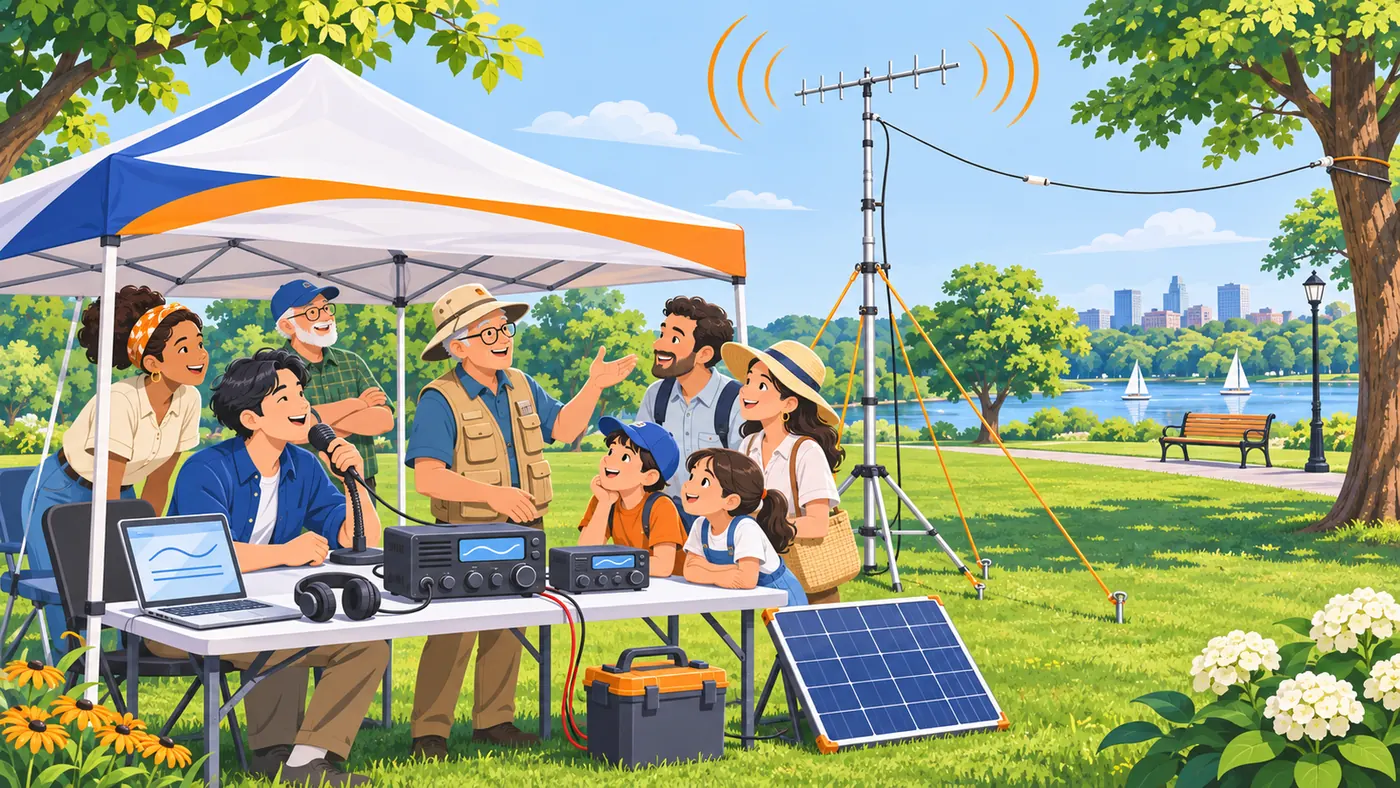
Field Day is the biggest on-air event of the year in North America. Clubs and individuals set up portable stations, often on emergency power, and try to contact as many stations as they can in 24 hours. It is also the easiest way for a new ham to get on the air with help nearby.
Updated 2026-10-31 · Source: ARRL Field Day rules and the ARRL Field Day page
When is Field Day 2027?
Field Day is always the fourth full weekend of June. In 2027 that is Saturday June 26 to Sunday June 27.
Under the current ARRL rules, the operating period runs from 1800 UTC Saturday to 2059 UTC Sunday. Stations that start setting up before 1800 UTC Saturday may operate for 24 consecutive hours; stations that start setting up at or after 1800 UTC Saturday may use the full 27 hours. Check the 2027 rules packet when ARRL publishes it, because details can change each year.
Entry classes
Every station sends its class as part of the exchange. The number in front is how many transmitters it runs at once.
| Class | Who |
|---|---|
| A | A club or group of three or more, set up for Field Day away from its usual location, on power independent of commercial mains |
| B | One or two people with a portable station |
| C | A mobile station in a vehicle |
| D | A home station on commercial power |
| E | A home station on emergency power |
| F | A club or group station at an Emergency Operations Center (EOC) |
The exchange: class and section
A Field Day contact is short. You send your class and your ARRL/RAC section, for example "3A CT" on CW or digital, or "3 Alpha Connecticut" on phone. Stations outside the US and Canada send their class and "DX".
A phone contact is worth 1 point. A CW or digital contact is worth 2 points. Clubs also collect bonus points, for example 100 points for running entirely on emergency power or for setting up in a public place.
What a Technician can operate
Your frequency privileges depend on the license class of the control operator (T1E04). As a Technician you can work Field Day on 6 meters, 2 meters and 70 centimeters with full privileges, plus your HF privileges:
- 10 meters phone, 28.300 to 28.500 MHz. This is the only HF band where Technicians have phone privileges (T1B06).
- CW on parts of 80, 40, 15 and 10 meters.
- Digital modes such as FT8 on the bands where you have privileges (T1B05).
- Satellite contacts, which also earn a bonus point award. See satellites and the ISS.
- T1B01 Which of the following frequency ranges are available for phone operation by Technician licensees?
28.300 MHz to 28.500 MHz - T1B02 Which of the following U.S. amateur radio operators are allowed to contact the International Space Station (ISS) on VHF bands?
Any amateur with a Technician class or higher license - T1B03 Which frequency is in the 6-meter amateur band?
52.525 MHz - T1B04 Which amateur band includes 146.52 MHz?
2 meters - T1B05 Which of the following bands include frequencies where Technicians are authorized to use digital modes such as FT8?
All these choices are correct - T1B06 On which HF bands does a Technician class operator have phone privileges?
10-meter band only - T1B07 Which of the following VHF/UHF band segments are limited to CW only?
50.0 MHz to 50.1 MHz and 144.0 MHz to 144.1 MHz - T1B08 How are US amateurs restricted in segments of bands where the Amateur Radio Service is secondary?
U.S. amateurs may find non-amateur stations in those segments, and must avoid interfering with them - T1B09 Why should you not set your transmit frequency to be exactly at the edge of an amateur band or sub-band?
All these choices are correct - T1B10 Where may SSB phone be used in amateur bands above 50 MHz?
In at least some segment of all these bands - T1B11 What is the maximum peak envelope power output for Technician class operators in their HF band segments?
200 watts - T1B12 Except for some specific restrictions, what is the maximum peak envelope power output for Technician class operators using frequencies above 30 MHz?
1500 watts
GOTA: the station for newcomers
Many Class A clubs run a GOTA (Get On The Air) station. It is set aside for newly licensed hams and for people who have not been active, and it uses its own call sign for the whole weekend. The club earns bonus points for every GOTA contact, so it wants you to use it.
Under current rules, anyone licensed since the previous year's Field Day can operate GOTA, whatever their license class. People without a license can also make contacts under the direct supervision of a licensed control operator. That makes Field Day a good way to try radio before you take the exam.
Your first Field Day visit
- Find a site with the Field Day Station Locator on the ARRL website, or ask a local club.
- Bring water, a hat, sunscreen and a chair. Many sites are outdoors in a park all weekend.
- Tell the first person you meet that you are new. Someone will show you how to log a contact.
- Listen to a few contacts before you make your own. The exchange is the same every time.
- Stay away from generators and fuel, and watch for antenna guy ropes and coax on the ground. See electrical safety.
Questions people ask
When is ARRL Field Day 2027?
June 26-27, 2027, the fourth full weekend of June. Under current rules operating runs from 1800 UTC Saturday to 2059 UTC Sunday.
Can a Technician operate on Field Day?
Yes. Technicians have full privileges on 6 meters and up, phone on 10 meters from 28.300 to 28.500 MHz, and CW on parts of 80, 40, 15 and 10 meters.
Can I take part without a license?
Yes, at a GOTA station or any Field Day station, as long as a licensed control operator directly supervises you.
What do I say in a Field Day contact?
Your class and section, for example "2A WTX" on CW or "2 Alpha West Texas" on phone.
Take a practice examPractice by topic
More guides
- Technician frequencies and privileges
- Technician vs General license
- How the Technician exam works
- Formulas for the Technician exam
- How to renew a ham radio license
- How to get a vanity call sign
- The phonetic alphabet for ham radio
- Repeater basics for new Technicians
- RF exposure safety, explained simply
- How to make your first contact
- Antenna basics for new hams
- How radio signals travel
- Electrical safety at your station
- Emergency communications for new hams
- Coax, connectors and SWR
- Amateur satellites and the ISS
- Digital modes and internet linking
- Technician study plan
- Electronic components on the Technician exam
- Do you need Morse code for a ham license?
- What you can't transmit on ham radio
- Ham radio Q codes and what they mean
- Fixing radio interference (RFI)
- How to sign up for the real exam
- Your first radio
- Ham radio calculators